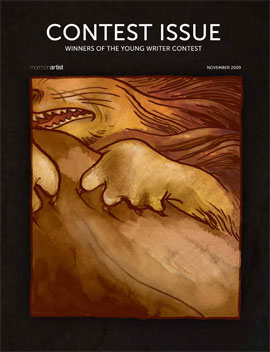
Contest Issue
November 2009
Download PDF
Frontmatter
- Frontmatter
- Editor’s Note
- Introduction, by James Goldberg
- About the Authors
Honorable Mentions
- “Blind Man,” by Davey Morrison Dillard
- Interview with Davey Morrison Dillard, by Katherine Cowley
- Essay on “Blind Man,” by Katherine Cowley
- “For the Man in the Red Jacket,” by Tyler Chadwick
- Interview with Tyler Chadwick, by Ty Campbell
- Essay on “For the Man in the Red Jacket,” by Ty Campbell
Third Place
- “Coring the Apple,” by Sarah E. Page
- Interview with Sarah E. Page, by Boyd Petersen
- Essay on “Coring the Apple” and “Adam and Eve,” by Boyd Petersen
Second Place
- “Faith,” by Eliza Campbell
- Interview with Eliza Campbell, by Gideon Burton
- Essay on “Faith,” by Gideon Burton
First Place
- “Adam and Eve,” by Davey Morrison Dillard
- Interview with Davey Morrison Dillard, by Boyd Petersen
- Essay on “Adam and Eve” and “Coring the Apple,” by Boyd Petersen
Epilogue
- “Tales of Teancum Singh Rosenberg,” by James Goldberg
- Explanation of Names, by James Goldberg
- Interview with James Goldberg, by Nicole Wilkes
- Essay on “Tales of Teancum Singh Rosenberg,” by Nicole Wilkes
