
Patricia Karamesines
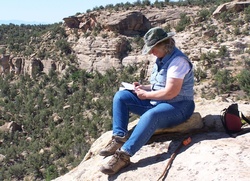
Nature and language use are common themes throughout your writing. What about your early life influenced those themes?
I came with standard issue kid-interest in critters. I just never grew out of it. When I was about four, I snuck into the alley behind our house in Hopewell, Virginia. The alley was a gold mine of rotting cardboard hosting hundreds of pillbugs, sow bugs, and black beetles. I carried a chunk into the yard and shook it over a metal bowl. Insects rained down. Then a sinuous ribbon-creature slid out of the cardboard and plopped into the bowl. I’d caught my first snake. That moment of seeing such a beautiful, strange, rippling being hit so powerfully that I think I imprinted on snakes.
Later, we moved to a rural environment. Lots and lots of snakes. I used to catch mole snakes and stuff them in my shirt against my skin until they got hip to the niceties of body contact with a warm-blooded creature. Then I let them wrap around my wrists and neck and took them for bike rides. They stayed there like living bracelets and necklaces while I pedaled. When the ride was over, I put them back where I found them. I enjoyed their companionship immensely. I discovered turtles when we lived on that property. They made an even deeper impression.
Hunting for these creatures, handling them, and learning to read their body language all created a feast for the senses and gave me an eye for detail. Before I learned to read books, I was reading nature, which has a compelling story to tell. How did this give rise to my desire to write, particularly nature stories? Maybe just as I imagined then that snakes would only ever know what it was like to ride bicycles if I carried them, I imagine now that many people will only experience snippets of nature’s unfolding narrative if I pedal them forth.
How did your desire to write develop?
I used to write adventure stories that included childhood friends and then read them to the other kids. It was a different way of playing from shooting hoops or playing 500 in the field next door but still seemed satisfying to everybody involved. In my teen years, writing and finding my way in language became a means of developing identity and exercising self-expression: “There’s a star up there, somewhere, for me / And perhaps it’s one of the hard ones to see…” kinds of stuff. In my early twenties, I started writing artsier poetry but stuck to my self-expression guns, trying to make that interesting—until I joined a BYU archaeological dig and lived in the desert for three months with the same people, four summers in a row. We became each other’s safety nets as well as risk factors, each other’s work support as well as challenges, each other’s muscle as well as each other’s weakness when difficulties arose. Just as importantly, we were each other’s source of entertainment. Living so closely with people who coalesced into an extra-domestic family, I started to develop a more not-me-focused sense for community and audience. That helped snap me out of my self-expression rut.
How did your conversion to the Church affect your writing?
It gave my writing just about everything. It set me on a trajectory for attending BYU, where my mind took off and where I found companionship with thinkers and writers, specifically with professors who were able to guide me. At BYU, I learned to give careful reading to scripture. Gaining that skill affected my thinking in subtle ways as well as flamboyant ones. Often I’d explore scriptural stories and other sacred language through my poetry and prose. Still do.
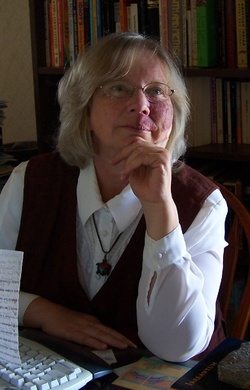
How were you influenced by Leslie Norris and other writers?
Many teachers at BYU affected me deeply, but Clinton Larson, Leslie Norris, and Arthur King not only taught special reading and writing skills but also kept close and watchful company as I went through many spiritual and intellectual growth spurts. Clinton schooled me in poetic form and literary tradition. Leslie Norris taught me literary common sense and encouraged my growing interest in audience (not, by the way, one of Clinton’s strong points). Arthur—what can I say about him? I spent so much lovely time with him that I still feel his presence. He gave wonderful advice without imposing himself and always handled my writing with tender care. His classes in rhetorical analysis with emphasis on Shakespeare’s plays opened my eyes to scripture and to the power and effects of logos. My life wouldn’t be nearly as much fun as it is now if I hadn’t kept company with Arthur.
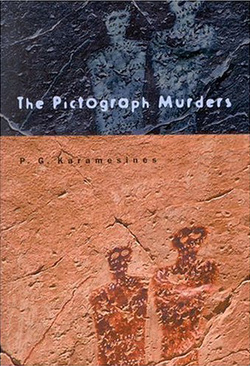
In a comment posted on the Times and Seasons blog in response to Rosalynde Welch’s review of The Pictograph Murders, you said, “I tried to write as many levels as possible into the book.” How do you develop and keep track of the different levels?
For Pictograph Murders, I turned to folklore and myth to find language that a wide audience could approach, wove that into a more traditional narrative stance, and sprinkled throughout the kind of prose people expect to find in literary fiction, but not too much, because that kind of language can write some readers out of the audience. The Coyote trickster tradition the story taps into is a very old, very popular Native American narrative tradition that is by nature multi-layered. Sometimes I retold a difficult segment of the story in a folktale version to provide another way into the ideas. I related the murder as a folktale-like segment of the story to help out those who, like me, have problems with portrayed violence, reaching into the archetypal realm to examine the question of why people kill. As I edited, I threaded in metaphors, which for some readers open up multiple levels of meaning and for others makes the language pretty. Probably, I applied other touches I’m not completely aware of.
Even though the story is a serious one, involving murder and conflict, I reached a point where I tried not to take the story or myself writing it too seriously. That helped me avoid limiting the take-away factor for readers.
In the same comment you said, “I hope that anybody approaching this work will find material they can have fun with.” Several other commenters used the word “fun” in connection with their reading of the book. Could you expand a little on what you think the role of fun is in writing?
At times, Pictograph Murders gets intense. Readers have reported feeling frightful strain during some scenes, especially ones involving the antagonist, whose behavior affects some people strongly. A book that’s all strain and no fun can hammer readers, many of whom already experience a lot of strain in their lives (me included) and don’t need to be relentlessly pummeled with more.
So I varied the narrative approach to give readers’ minds something new to do from time to time. I showed them something of field camp life, I concocted the faux folktales, I played with the desert’s beauties, I sent the slovenly camp cook to the deerfly-infested creek, I gave the dog (who, by the way, was based closely on a husky named Ruby who actually had some of the adventures that Kit does) a starring role, etc. Fun equals play: wordplay, plot twists, trusting and enjoying the ride the story took me on as I wrote it. I played with the story every way I possibly could. That made it fun for me. At that point in my life, I needed fun.
You’ve written that Joseph Smith went to the woods because “he wished to live deliberately” and that “through Joseph Smith’s First Vision, Mormonism stakes claim in the grand tradition of finding God in the wilderness.” How does the wilderness inspire your writing?
Joseph Smith’s reasons for going to the woods bear important similarities to Thoreau’s stated reasons for retreating to Walden Pond. To my eye, both men account for their actions in language comparably spiritual in nature. At other times, Joseph encountered God or God’s delegates within the four walls of buildings. His spirituality appears not to have been bounded by traditional hot zones for sacred encounter—chapels, temples, other dedicated enclosures. Spirituality is a quality of character, not of place, though there are certainly places—temples, church buildings, wherever two or three gather together to talk of truth, charged natural settings—where events that light spiritual fires happen more easily.
On the spirituality scale, for me, many encounters with nature are not different in degree from encounters with the sacred in any of the hot spots I mention above and are only slightly different in kind. I can’t distinguish between the spirituality buzz I get from experiences in nature, ones I get from wondrous encounters with people, and experiences with prayer or related communication with God.
Let me just say this: I will never write about nature just for the sake of writing about nature. Always, in the foreground or background of the nature writing, lurks my affection for people and invested interest in the human condition. Of course, concern for the human condition lies at the heart of the best scriptural writings, as well. So I’m not certain that wilderness per se inspires my writing.
I do think it wouldn’t hurt Mormonism as a culture to develop a closer relationship with wild species and spaces and not fret so much about making the desert blossom with Kentucky blue grass. If even just a few Latter-day Saints who are inclined to do so integrate experience with nature more deeply into their concepts of spirituality, that will make us a sexier people overall.
What do you hope to achieve through your blog, Wilderness Interface Zone?
I believe that many Mormons bear strong affection for nature and may even have had powerful spiritual experiences in natural environments (why should Joseph Smith have had all the fun?) but don’t know what to do with them.
I hope WIZ’s message that it’s all right to explore and share such moments through nature literature will help open up the nature–human story for Mormon audiences as well as for non-Mormon audiences and for aspiring LDS nature writers. WIZ tries to take a different approach to nature writing, more of a campfire ring stance than a fully academic or political one. A friend—a seasoned desert rat—once told me, “A campfire melts the molecules between people.” I’ve certainly been at campfires where everyone present felt free to tell his or her story without trouble. Trying for this approach gives WIZ, I think, more of the feel of an open forum.
Other than that, I don’t know what’s going to happen at WIZ. I’m perfectly happy to let nature take its course.
What is the local awareness of, and what has been the local reaction to your writing?
They’re beginning to find out about it and are interested for many reasons. The story mentions landmarks they know and plays off events which some find familiar. The history between archaeologists, activists, Native Americans, federal interests in the area and the local residents is a charged-up and long-running drama in the Four Corners region, with some very hard and tragic chapters only recently being written.
The locals, many of them multi-generation Mormons, are always interested to see how they’ve been portrayed. From what I’ve heard so far, local readers really like the book, saying they could hardly put it down. Nobody has walked up and tried to shove it down my throat.
What projects are you working on? Is there another novel in the works?
Yeah, I’m wondering that too. Here’s my wish list: I’d like to get a volume of poetry done in a year or so. I’d like to finish Loon Woman, the sequel to The Pictograph Murders. I’d like to build up Wilderness Interface Zone. I hope to break into nature writing in a more forthright way, engaging the conversation at large. People have expressed here and there a wish for some of my online essays to be compiled into a book or some other collected format.
Over the years of motherhood and of being primary caregiver to an at-risk special needs child, I’ve had to adopt the “wait and see” model for planning. That’s all I can say at this point—let’s see what I manage to get done.
Do you have any encouraging advice for aspiring Mormon nature writers?
Along with honing your language skills, take science classes or get involved in environmental science programs. Read nature writing to get a sense for the tradition, even though sometimes it will infuriate you (it should). Don’t mistake the nature writing genre for “people is stupid” writing that tends to exert squeaky wheel influence in every genre. People are absolutely essential to the nature story.
Look for ways in writing to make it possible for readers to care about what you care about—open the view where you can, expand possibilities. Don’t fall into the trap of trying to motivate through anger, fear, guilt, or shame.
Anger is needful at times—like fear, it can get you out of trouble, fast. Where nature writing is concerned, anger-suffused language affects the environment. Same with fear—using it as a common rhetorical device has unfortunate effects upon nature and man. The effluvium of anger and fear trickle down into natural environs quite easily through unimagined channels. To my thinking, that makes the quality of human language an environmental concern.
Guilt and shame cast wide nets, like the long nets fishermen use to harvest tuna but which also entangle other species. Many, many people carry guilt or shame from trouble not their fault and are terribly sensitive to such language. It will hurt them or restrict their freedom of movement in your language, maybe even turn them out from your audience. Most of all, get out there—not only into natural wildlands but human ones too in acts of engaged relationship. ❧